
Visit our UK website

Across India, clinics are rethinking how they manage patient information, appointments and everyday administration. The growing adoption of electronic medical records India is helping practices move beyond paper files towards a more organised, connected way of working. But going digital isn't simply about replacing paperwork with software. From easier access to patient histories to better continuity and more efficient clinic processes, we explore why electronic medical records are becoming an increasingly important part of the modern Indian healthcare experience.
Walk into many clinics across India and you will still see something very familiar: files.
Sometimes there are shelves full of them. Sometimes patient records are stored behind reception, and sometimes there is a mixture of handwritten notes, printed reports, spreadsheets and information saved across different systems.
For years, this has simply been how many practices have worked. And, to be fair, paper records can feel straightforward when a clinic is small and the same doctor has been seeing the same patients for years.
But as patient numbers increase and expectations change, that approach can become harder to manage.
The growing adoption of electronic medical records India is partly about technology, of course, but I think the bigger story is about making everyday clinic management simpler. Doctors and their teams need patient information to be available when they need it, without searching through files or relying on someone remembering where a particular document was stored.
And patients are changing too. Many now expect healthcare to offer some of the same convenience they experience elsewhere, particularly when booking appointments, receiving information or communicating with a clinic.
So, is it time for more Indian clinics to move away from paper?
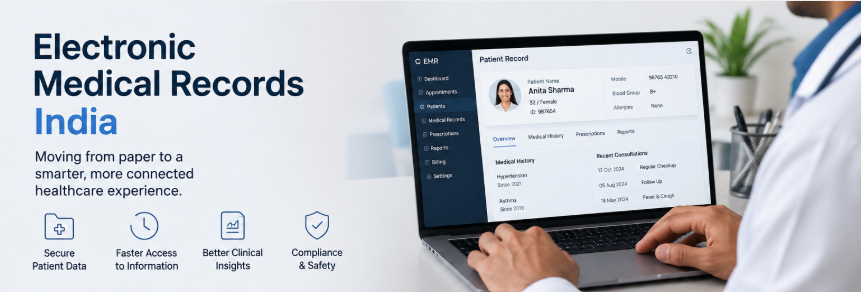
An Electronic Medical Record, usually shortened to EMR, is a digital version of the patient information traditionally kept within a paper medical file.
Depending on the system being used, this could include a patient’s medical history, previous consultations, diagnoses, prescriptions, test results, allergies and other information relevant to their care.
Instead of finding the correct physical file each time a patient visits, authorised clinic staff can access the relevant information digitally.
It sounds like quite a simple change. In practice, though, it can affect quite a few parts of how a clinic operates.
Good EMR software India can help bring information that would previously have been scattered across paper files, computers or different administrative processes into a more organised digital environment.
For a busy clinic, that can make a noticeable difference.
Paper isn’t necessarily a problem simply because it is old fashioned. The bigger issue is what happens as a clinic becomes busier.
Imagine a patient returning after several months. Their file needs to be located, previous notes checked and any recent information added. If something has been filed incorrectly or the record isn’t where expected, someone has to spend time finding it.
One missing file might only take a few minutes to resolve. Repeated across dozens of patients and hundreds of appointments, however, those small delays start adding up.
Handwritten records can also be difficult to search and analyse. If a doctor wants to understand a patient’s history quickly, they may need to work through several pages of notes.
Digital records don’t magically remove every administrative challenge, but they can make information considerably easier to organise, retrieve and update.
The shift isn’t only happening inside the clinic.
Across India, people are becoming accustomed to managing more of their lives through their phones. Banking, shopping, travel and payments can all be handled digitally, often within a few minutes.
Healthcare is naturally more complex, and it shouldn’t be treated exactly like ordering food or booking a train ticket. Still, patient expectations around convenience have changed.
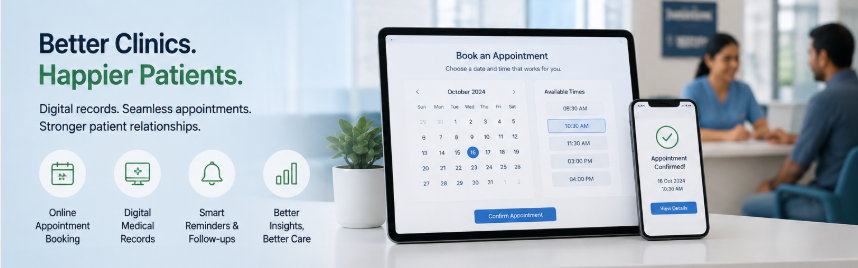
Something as straightforward as online appointment booking for doctors can remove the need for patients to call during clinic hours simply to find an available slot. They can make a booking at a time that suits them, while the clinic has a clearer view of upcoming appointments.
For reception teams, that can also mean fewer routine calls competing for attention while they are helping patients already at the clinic.
This is where digitalisation starts to become more interesting.
An EMR shouldn’t necessarily be viewed as an isolated replacement for the paper file. It can form part of a wider digital approach to managing the patient journey.
Consider what normally happens when somebody visits a clinic.
They book an appointment, arrive at reception, wait to see the doctor, have their consultation and may then require a prescription, investigation, follow up appointment or another form of communication.
If every stage is managed separately, staff can find themselves repeatedly entering the same information or moving between different systems.
Connecting patient records with appointment and practice management tools can make that journey feel less fragmented.
For doctors exploring EMR software India, it is therefore worth looking beyond the basic question of whether the software can store medical records. Think about how it fits into the way the whole clinic operates.
Can staff manage appointments easily? Can doctors find the information they need during consultations? Is it straightforward to update a patient record? Can the system support the clinic as it grows?
Those practical questions tend to matter much more after the initial excitement of introducing new technology has passed.
There is another benefit that is perhaps less immediately obvious.
When patient information is organised consistently, it becomes easier to understand what has happened previously.
A doctor can review earlier consultations and relevant information without relying on a patient’s memory or searching through several physical documents. This can be particularly useful for people who return regularly for ongoing care.
For patients, there is reassurance in not having to explain everything from the beginning at every visit.
For clinicians, having clearer information available can help them approach the consultation with a better understanding of the patient’s history.
That continuity matters.
There can sometimes be an assumption that digital healthcare systems are mainly designed for hospitals or large multispeciality organisations.
That isn’t really the case anymore.
A smaller GP, specialist or independent clinic can face many of the same administrative frustrations, just on a different scale. In fact, when there are only a few members of staff, spending time searching for records, answering appointment calls or repeating administrative tasks can have an even more noticeable impact.
The aim shouldn’t be to introduce technology for the sake of appearing more modern.
It should make the clinic easier to manage.
For example, combining digital patient records with online appointment booking for doctors can help reduce some of the manual work around both appointments and consultations. Staff can spend less time managing routine processes and more time helping the patients in front of them.
India’s wider healthcare landscape is changing as well.
The development of national digital health initiatives, including the Ayushman Bharat Digital Mission (ABDM) and ABHA, reflects a much broader move towards connected digital healthcare.
For individual clinics, this doesn’t mean everything needs to change overnight. Moving from familiar processes to new technology takes time, and staff need to feel comfortable using it.
A gradual approach can sometimes make more sense.
Start by identifying the areas creating the most unnecessary work. Perhaps appointment management is taking up too much reception time. Maybe patient records are becoming difficult to organise. Or perhaps information is spread across several places and staff are constantly switching between them.
Once you understand the problem, it becomes easier to decide which technology might actually help.
There are plenty of systems available, and the number of features can quickly become confusing.
Instead of starting with a long feature checklist, think about how people will actually use the system during a normal working day.
Is it simple enough for staff to learn? Can doctors access relevant information quickly during consultations? Does it fit with your existing workflow? Can it grow with your practice?
Security and patient data protection should naturally be part of that conversation too.
The right solution should feel like it is removing steps rather than adding another layer of administration. If staff have to develop complicated workarounds just to use the technology, something has probably gone wrong.
The conversation around electronic medical records India is ultimately part of a much wider shift in how clinics operate.
Moving away from paper doesn’t mean removing the personal side of healthcare. Quite the opposite, really. When technology takes care of some of the repetitive administrative work, doctors and clinic teams potentially have more space to focus on patients.
For some practices, the first step might be introducing digital medical records. For others, it could be improving appointment management, building a better website or connecting several existing processes.
There isn’t one perfect route.
What matters is that digital technology solves a genuine problem for the clinic, its staff and, importantly, its patients.
At Silicon Practice India, we help healthcare organisations introduce practical digital solutions designed around the way modern clinics work. From patient facing websites and digital appointment journeys to practice management and digital records, our aim is to make technology useful in the everyday running of healthcare.
Because becoming a digital clinic isn’t really about having more technology.
It’s about making the technology you use work better for the people who rely on it.