
Visit our UK website

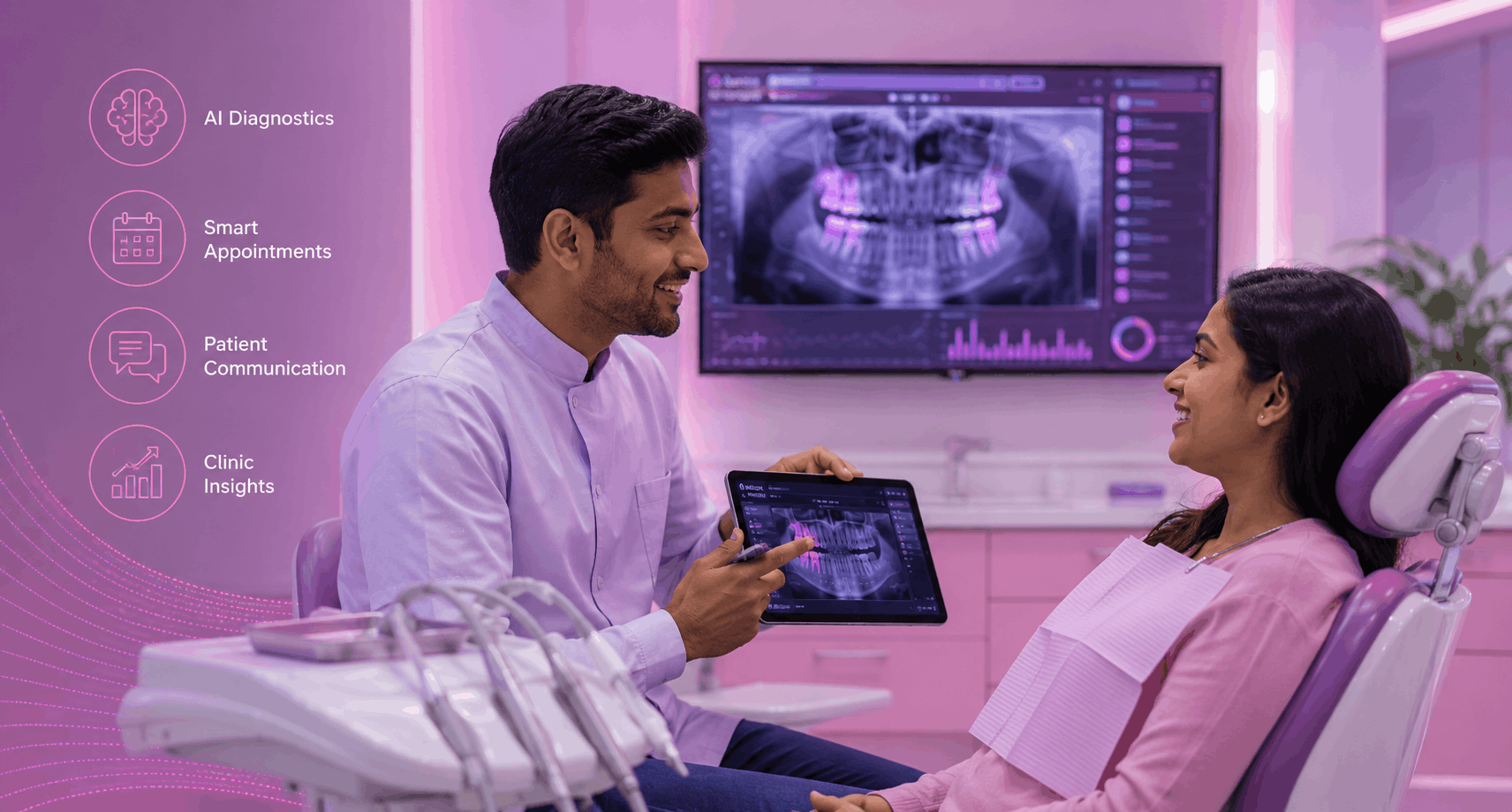
AI in dentistry is no longer just a future trend discussed at conferences or in technology blogs. Across India, dental clinics are beginning to use AI-supported tools to improve communication, streamline administration and create smoother patient experiences day to day. From automated reminders to smarter workflows and digital treatment planning, the changes are often subtle but increasingly noticeable. This blog explores nine practical ways dental AI is quietly reshaping modern dental practices in India, without losing the human side of patient care.
A few years ago, most conversations around technology in dental clinics focused on fairly practical things. Online appointment booking. Digital patient records. Perhaps moving away from paper forms that somehow always disappeared at the worst possible moment.
Now though, the conversation has shifted quite noticeably towards AI in dentistry, although perhaps not always in the dramatic way social media headlines suggest.
Most dentists are not trying to create futuristic clinics filled with robots and automated everything. In reality, many practices across India are simply looking for ways to reduce operational pressure, communicate better with patients and make everyday workflows feel slightly more manageable by the end of a long day.
And quietly, without a huge amount of noise, that shift already seems to be happening.
A 2025 survey found that awareness of AI technologies in dentistry had reached almost 80%, while around 60% of respondents said they had already integrated some level of AI into their workflows. What feels interesting is that many clinics may already be using AI-supported systems without fully thinking of them as “AI” at all.
One of the less discussed realities of running a dental clinic is just how repetitive communication can become across a normal week.
Patients ask whether they should eat before treatment. Whether the clinic is open on Sunday. Whether sensitivity after scaling is normal. Whether the prescription can be resent because the WhatsApp message disappeared somewhere in family group chats.
Individually, these interactions are completely reasonable. Together though, they create a surprising amount of background pressure for front desk teams.
This is where dental AI is beginning to help in a fairly practical way, especially through automated reminders, follow up instructions and FAQ support that can handle routine communication without removing the human side of the patient experience entirely.
Research around artificial intelligence in dentistry suggests AI-supported systems are increasingly being used to improve patient communication, education and engagement, particularly through automated support and digital interaction.
A clinic owner in Bengaluru described it quite casually during a conversation recently. He said the clinic felt “less noisy” after introducing more automated communication. Not quieter physically perhaps, but mentally. That distinction probably makes sense to anyone who has worked reception during a busy evening clinic.
One thing dentists know, although patients perhaps do not always realise it themselves, is that people often leave consultations having understood only part of what was explained to them.
Not because the dentist communicated badly.
Usually because patients are anxious, distracted, overwhelmed by terminology or simply thinking about cost while trying to process clinical information at the same time.
Some AI-supported imaging and visualisation tools are helping simplify these discussions by making treatment explanations more visual and interactive. Patients can sometimes see potential issues more clearly rather than trying to interpret complicated explanations verbally.
Interestingly though, this does not always make consultations shorter.
In some clinics, consultations become slightly longer because patients ask more questions once they understand the images better. But perhaps that is not a bad thing. A more informed patient generally feels more confident moving forward with treatment, even if the conversation itself takes additional time.
This area feels surprisingly important because follow up communication is often where patient experience either strengthens or quietly falls apart.
In busy practices, follow ups depend heavily on whether somebody remembers to send them manually between appointments, billing queries and incoming calls. Some clinics manage this brilliantly. Others struggle because the day moves too quickly and priorities shift every few minutes.
AI-assisted systems can now automate post-treatment instructions, oral hygiene reminders and appointment recalls without requiring staff to manage every message individually.
And patients genuinely notice this kind of thing.
A lot of online reviews now mention communication quality more than clinical complexity. Patients remember whether the clinic checked in afterwards, whether instructions were clear and whether they felt supported after leaving the chair.
It sounds small initially, but perhaps small experiences shape trust more than clinics sometimes expect.
There is a less glamorous side to AI in dentistry that probably deserves more attention because it affects the day to day running of practices quite significantly.
Operations.
Dental clinics generate huge amounts of operational data every week. Missed appointments. Delayed billing. Waiting times. Last minute cancellations. Treatment drop-offs halfway through care plans.
Usually, nobody has time to analyse all of this properly because the clinic is focused on simply getting through the day.
AI-supported systems are beginning to identify patterns automatically, including repeated bottlenecks or scheduling inefficiencies that might otherwise go unnoticed for months.
One recent industry report suggested that AI-supported workflows may help reduce operational costs by 20 to 30%, while also improving patient satisfaction through faster communication and clearer treatment explanations.
Now, obviously not every clinic will suddenly reduce costs dramatically overnight. Real life rarely works that neatly. Still, even reducing a small amount of operational friction can noticeably improve how a practice functions during busy periods.
Dentists rarely enter the profession because they enjoy administration, yet paperwork and documentation continue to consume a large part of the day in many clinics.
Clinical notes. Billing records. Insurance documentation. Patient histories. Consent forms.
Individually manageable perhaps, but together they create a constant layer of interruption around clinical work.
Some AI-supported tools are now helping automate documentation workflows and organise records more efficiently, particularly in larger or multi-speciality clinics where administrative pressure tends to grow very quickly.
There is still caution here though, and probably rightly so.
Most dentists understandably want clinical oversight to remain central to documentation and decision making. Full automation without review still makes many practitioners uncomfortable, especially when patient care is involved.
That hesitation actually feels healthy rather than resistant.
Patients across India increasingly expect dental clinics to operate with the same convenience they experience elsewhere in everyday life.
They expect digital booking. Faster responses. Automated reminders. Online communication. Shorter waiting times. Easier access to records and instructions.
Not necessarily because patients have become impatient, but because digital experiences in banking, shopping and healthcare more broadly have quietly reshaped expectations over time.
And dental clinics are now adapting to that reality.
Some reports suggest around 40% of dental professionals are already using AI in some form within their workplace, although opinions remain mixed around how quickly clinics should expand that use further into clinical workflows.
That uncertainty feels understandable honestly. Many clinic owners are interested in innovation, but they are also cautious about disrupting systems that already work reasonably well.
There was a time when advanced technology felt accessible only to large hospital groups or premium urban clinics with very large budgets.
That gap has started narrowing.
Cloud-based software and subscription platforms are making AI-supported systems more accessible to independent practices and growing dental clinics across India, particularly those trying to modernise gradually rather than completely rebuilding workflows overnight.
Sometimes the language around AI still creates hesitation because it sounds expensive or overly technical. But many clinics are already using AI-supported features without necessarily labelling them that way.
Smart appointment scheduling. Automated patient communication. Predictive reminders. Workflow optimization.
These tools are quietly becoming normal parts of everyday practice management.
Interestingly, not every new AI feature is being welcomed enthusiastically anymore.
There is a little fatigue developing around constant promises of “revolutionary” technology, especially when some products appear more focused on marketing than solving practical clinic problems.
The clinics seeing the best results tend to approach technology more cautiously and perhaps more realistically.
Does it save time?
Does it improve communication?
Does it reduce stress for staff?
Does it actually integrate properly with existing systems?
Those questions usually matter far more than whether something sounds futuristic during a software demonstration.
And honestly, that feels like a healthier way to approach innovation in healthcare generally.
After all the conversation around automation and intelligent systems, this part probably matters most.
Dentistry remains deeply personal for patients, especially because anxiety, trust and communication still shape so much of the experience from the patient perspective.
People remember whether the dentist explained things calmly when they were nervous. They remember whether the receptionist stayed patient during delays. They remember whether someone followed up afterwards when recovery felt uncomfortable or uncertain.
Technology can absolutely support those experiences by reducing friction, improving organisation and helping clinics communicate more consistently during busy periods.
But most patients are not choosing clinics because they use AI.
They are choosing clinics because the experience feels reassuring, organised and human from beginning to end, which perhaps explains why the most successful use of artificial intelligence in dentistry is often the least visible kind.
The technology works quietly in the background while the clinic itself still feels personal, calm and genuinely focused on care, and honestly that version of the future feels far more believable than the dramatic headlines people often associate with AI.