
Visit our UK website

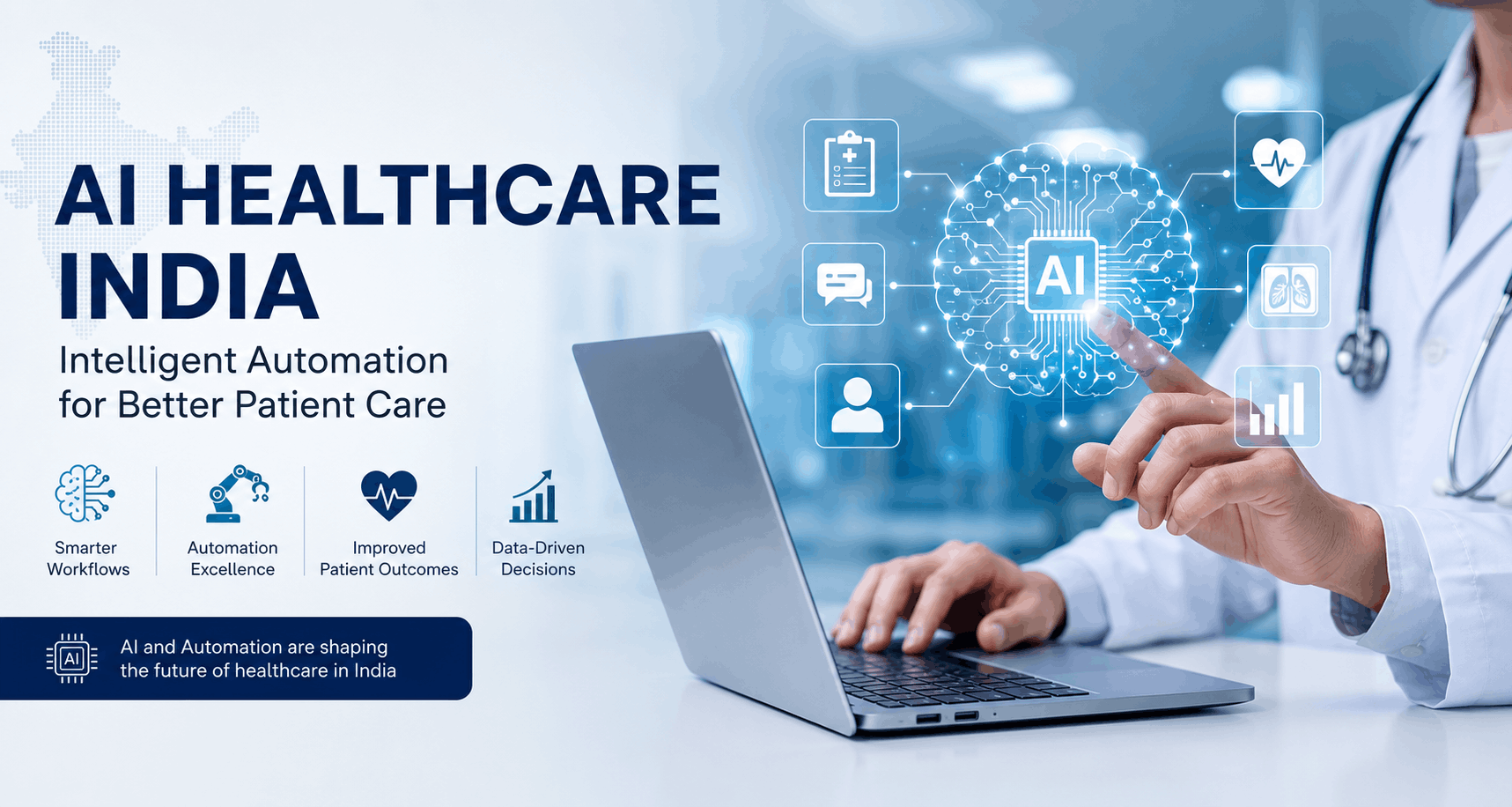
Artificial intelligence is rapidly transforming healthcare across the country, and AI healthcare India is becoming a key focus for clinics, hospitals and healthcare leaders. From improving patient engagement and streamlining administration to supporting smarter decision making, AI is helping organisations work more efficiently while enhancing patient care. This blog explores how technologies such as robotic process automation and intelligent automation are reshaping healthcare delivery in India, and why many providers see AI as an important part of their digital transformation journey.
Artificial intelligence seems to be everywhere right now.
A few years ago, conversations about AI in healthcare often felt quite futuristic. The technology sounded promising, but for many healthcare organisations it remained something to watch rather than something to use. Today, that situation looks very different.
Across India, hospitals, clinics and healthcare providers are beginning to explore practical ways to use artificial intelligence to improve patient care, reduce administrative workload and support clinical decision making. In many cases, the shift is not happening because organisations want to be seen as innovative. It is happening because healthcare teams are under pressure and they are looking for smarter ways to manage growing demand.
The discussion around AI healthcare India is no longer about what might happen in the future. It is increasingly about what is already happening today.
India’s healthcare sector is facing a unique challenge.
Patient expectations continue to rise. Healthcare organisations are managing larger patient populations. At the same time, many providers are working with limited resources and busy clinical teams.
Anyone who has spent time in a clinic waiting area has probably seen it. Reception staff answering phones while checking in patients. Administrators chasing paperwork. Clinicians trying to balance patient care with documentation requirements.
These are not new problems.
What is changing is that technology is now capable of helping with some of these tasks in ways that were not possible even five years ago.
AI is increasingly being used to support appointment scheduling, patient communication, data analysis, medical imaging and operational management. Rather than replacing healthcare professionals, the goal is usually to help them focus more of their time on patients and less on repetitive processes.
That distinction is important because there is sometimes a misconception that AI is about replacing people. In reality, most healthcare organisations are looking for ways to make their teams more effective, not smaller.
One of the most practical applications of AI involves automation.
Healthcare organisations generate enormous amounts of information every day. Patient registrations, appointment requests, billing records, insurance documentation and clinical records all require processing.
Many of these activities follow predictable workflows. They are important, but they can also be repetitive.
This is where robotic process automation in healthcare is beginning to attract significant attention.
Robotic process automation, often called RPA, allows organisations to automate routine digital tasks that would otherwise require manual effort. For example, software can transfer information between systems, process patient records, generate reports or support appointment workflows without requiring constant staff involvement.
For healthcare providers, even relatively small efficiencies can create a noticeable impact. Saving a few minutes on a process that occurs hundreds of times each day can quickly add up.
I think this is one of the reasons adoption has accelerated. Healthcare leaders are not necessarily looking for dramatic transformation overnight. Often they are simply looking for ways to reduce friction.
While administrative efficiency is often the starting point, AI is increasingly supporting clinical activities as well.
In diagnostic imaging, AI tools are helping clinicians identify patterns that might otherwise be difficult to detect quickly. In patient engagement, intelligent systems can provide information, answer common questions and direct patients towards appropriate services.
Some healthcare organisations are also using predictive analytics to identify patients who may require additional support or intervention.
Of course, these technologies are not perfect.
Healthcare decisions still require human expertise, judgement and experience. AI systems work best when they complement clinical teams rather than attempt to replace them.
That balance is perhaps one of the most important lessons emerging from successful implementations around the world.
When people hear the term automation, they sometimes imagine complex robots or highly technical systems.
In reality, much of robotic process automation for healthcare operates quietly in the background.
A hospital might use automation to verify patient information across multiple systems. A clinic could automate appointment reminders and follow-up communications. Billing teams may automate routine claims processing activities.
Individually, these improvements might appear relatively modest.
Collectively, however, they can reduce delays, improve accuracy and create a better experience for both staff and patients.
Many organisations exploring robotic process automation in healthcare discover that the greatest benefits come from removing small operational frustrations that teams encounter every day. Those frustrations may seem minor in isolation, but they often consume valuable time and energy.
India is uniquely positioned to benefit from healthcare innovation.
The country has a rapidly growing digital ecosystem, increasing smartphone adoption and a strong focus on technology-led transformation. National initiatives supporting digital health are also helping create an environment where innovation can develop more quickly.
As healthcare providers continue their digital transformation journeys, AI will likely become less of a standalone technology and more of a standard part of everyday healthcare operations.
We may reach a point where organisations no longer talk specifically about AI. It will simply be embedded within the systems and processes they use every day.
That future may still be developing, but signs of it are already visible.
Healthcare providers are exploring new ways to improve efficiency. Patients are becoming more comfortable with digital services. Technology vendors are creating solutions that are increasingly practical rather than experimental.
At the same time, it remains important to remember that healthcare is ultimately a human service.
Technology can help streamline workflows, support decision making and improve access to information. However, trust, empathy and clinical expertise will continue to sit at the centre of patient care.
The conversation around AI healthcare India is evolving rapidly.
What began as a discussion about emerging technology is becoming a conversation about practical outcomes. Healthcare organisations are looking for solutions that reduce administrative burden, improve efficiency and help teams deliver better patient experiences.
Whether through intelligent analytics, digital patient engagement tools or robotic process automation for healthcare, the focus is increasingly shifting towards technologies that solve real operational challenges.
The healthcare organisations that succeed will probably not be the ones chasing every new technology trend. More likely, they will be the ones that carefully identify where innovation can genuinely support patients, clinicians and administrative teams.
Perhaps that is where the greatest opportunity lies. Not in replacing healthcare professionals, but in giving them more time to do what they do best.